
Lesson 3 of 3Lifecycle and modernisation
The analogue switch-off and lift phones.
Most lift emergency phones in the UK were installed on analogue phone lines, and that network closes on 31 January 2027. Here is what is changing, how the alternatives work, who is responsible for the line and what to do now so your lift alarms keep working.
What is changing.
The UK’s analogue landline network, the public switched telephone network (PSTN), is being replaced by digital phone services. The government says the PSTN “is old and is becoming increasingly unreliable”.
The date
“The UK PSTN will close on 31 January 2027.”
Openreach, GEN068/26: PSTN closure and post-January 2027 policies (25 September 2026)
The government’s own timeline says: “All users of the Openreach PSTN will need to be migrated to new services by the 31 January 2027”.
After that date, Openreach plans to move remaining lines, exchange by exchange, to a service it describes to the public as “a temporary emergency voice-only service that keeps basic voice calls working for a limited time”. Its briefing to phone companies is blunt about the limits: “Openreach does not guarantee that every line can be migrated because local capacity is or may be limited”, and “Some WLR are not capable of migration regardless of capacity and will thus need to cease.” Lines that are moved keep “only a limited set of calling and network features”.
In our view, that is no safety net for a lift alarm. Plan the change yourself, before the date.
Why lifts are affected.
A lift car must have a way for trapped passengers to call for help, and that call has to get through.
The law
“Cars must be fitted with two-way means of communication allowing permanent contact with a rescue service.” The means of communication must also “function even without the normal power supply”, long enough for the rescue procedure.
The Lifts Regulations 2016, Schedule 1, paragraphs 5(5) and 5(9)
Most lifts meet this with an autodialler: a unit that calls a 24-hour rescue service when the alarm button is held, and lets the passenger speak to them. Many were installed on analogue lines, and the government has written to building managers about it:
Government warning
“Most two-way voice alarms installed in passenger-carrying lifts in the UK rely on the PSTN. These alarms need to be migrated to digital alternatives, or they will no longer work once the PSTN has been switched off by January 2027.”
Department for Science, Innovation and Technology, letter to UK building managers (11 July 2025)
There is a second, less obvious change. The European Lift Association notes that “Most PSTN networks provided some power backups from the network itself”, so an analogue line kept working in a power cut. Digital lines do not do that, as the next section explains.
The three ways to connect.
A lift alarm can reach its rescue service in one of three ways. After the switch-off, only two of them will be left.
Describe this diagram
The lift alarm in the car can connect in one of three ways. First, an analogue copper line to the telephone exchange: the network closes on 31 January 2027. Second, a digital phone line through a router or adapter: the router needs mains power and a battery to work in a power cut. Third, a mobile 4G unit with a SIM card, through the mobile network: it needs a mobile signal and a battery. Each way ends with a rescue service answering the call.
| Connection | How it works | What to watch for |
|---|---|---|
| Analogue copper line | The traditional landline, which also carried power to simple equipment. | The network closes on 31 January 2027. Plan a change now. |
| Digital line | Calls travel over broadband, through a router and sometimes an adapter for older lift phones. | Ofcom: “Digital landlines need mains electricity and will not work in a power cut unless there is a battery back-up.” The router, any adapter and the lift phone all need backup power. |
| Mobile (4G) unit | A unit with its own SIM card calls over the mobile network. | It needs a reliable signal at the lift and a battery. Older 2G units will need replacing too. |
LEIA, the UK lift industry association, has recommended mobile units for a few years now: “At present, this will typically be a GSM solution incorporating a battery-backup. Since 2G and 3G are also due to be withdrawn in the coming years, we recommend a 4G solution, including SIM card.”
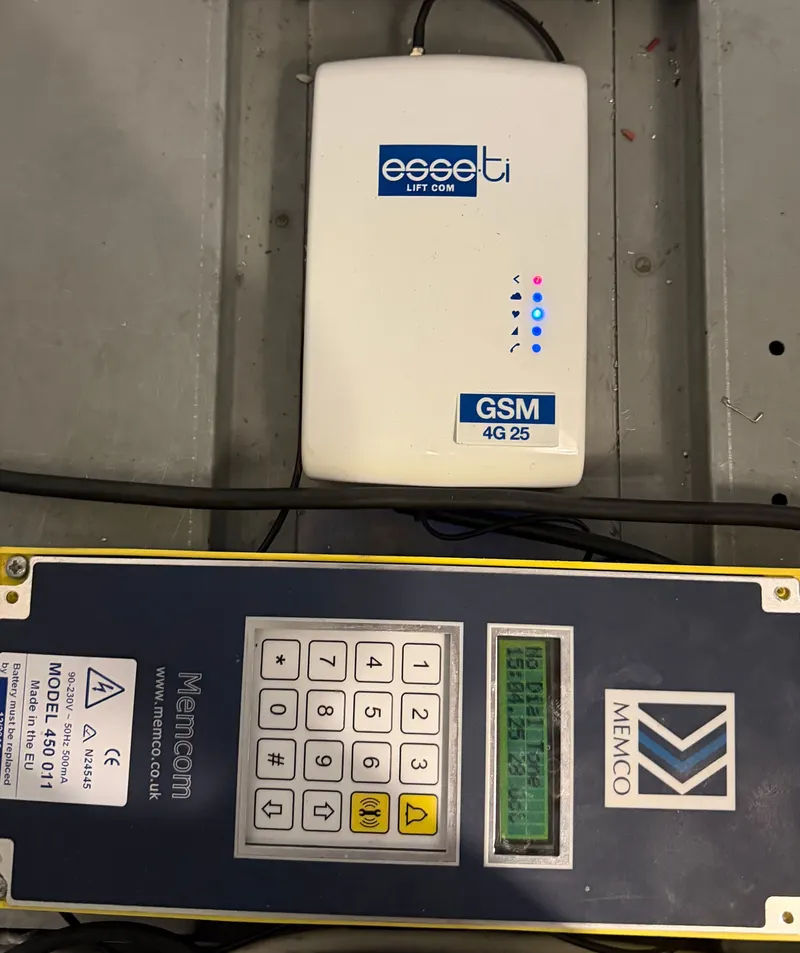
The mobile networks are changing too. The government’s timeline says EE will retire its 2G network nationwide from May 2029, Virgin Media O2 will start switching off 2G in summer 2029, and VodafoneThree’s 2G network will be switched off in spring 2030. If your lift already has a mobile unit, check which network generation it uses.
For a digital line, the European Lift Association warns that wired devices “must now be updated or extended to include a power supply and backup batteries”, and that the backup “must be provided for the devices of the lift as well as the other devices in the building which are necessary to ensure the voice communication.” Our lesson on power cuts and lifts explains why the alarm matters most when the power is off.
Who is responsible.
The phone line and the lift alarm are usually looked after by different people.
| Who | What they usually look after |
|---|---|
| Building or lift owner | The phone line or SIM, and the contract with the communications provider. LEIA: “The telephone line is typically the responsibility of the building/lift owner (not the lift maintenance company)”. |
| Communications provider | The line or mobile service itself, and telling customers about changes to it. |
| Lift maintenance contractor | That the alarm works, is programmed to reach the rescue service, and that its calls are received and acted on. LEIA’s code of practice also expects its operation, including the line, to be verified at least every 72 hours where the equipment supports it, and any backup battery to be checked regularly. |
| Rescue service | Answering alarm calls 24 hours a day and sending help. Often the maintenance contractor, but not always. |
LEIA’s code of practice puts it the same way: the responsible person should arrange a permanently available communications link, and the responsibility for it “is usually with the responsible person e.g. where the public telephone network is used.” Your contract should say who does what, and our guide to lift autodiallers and EN 81-28 covers the standard the equipment is built to.
What to do now.
The government’s letter asks building managers to contact two people: their communications provider and their lift maintenance provider. In practice, that means:
Find out what each lift phone uses
Ask your lift contractor what each lift’s alarm is connected to, and check your phone bills for lines you pay for. Record the answer for every lift, using the check sheet below.
Talk to your communications provider
Ask which of your lines are analogue, when they will change, and which digital services will keep your lift phones working. The government asks building managers to identify PSTN lines connected to devices such as lifts, and digital alternatives that enable their continued function.
Check compatibility before you buy
Ask your lift contractor whether the option you prefer will work with the lift phones you have. The government asks building managers to check this with their lift maintenance provider “prior to installation”.
Plan for power cuts
Make sure every part of the connection has backup power: the lift phone, and any router, adapter or mobile unit it relies on.
Test it end to end
After any change, the lift phone should be programmed and a test call made from the car to the rescue service. Ask for automatic test calls to be checked, and keep the results.
Safety first
If a lift phone fails its test call or cannot reach the rescue service, tell your lift contractor straight away. In our view, a passenger lift whose alarm cannot reach a rescue service should not carry passengers until it is fixed, unless your contractor and your risk assessment have put other arrangements in place.
Lifts are not the only thing on these lines. The government’s letter lists “lift alarms, landline telephones, fire and security alarms, door entry systems, and point of service machines” among the devices that use the PSTN. Check them at the same time.
Our lift autodialler team can survey, upgrade and test your lift phones.
Lift phone check sheet.
Use this sheet to record what each lift phone is connected to and what needs doing. Print it, or save it as a PDF.
Lift phone check
One row for each lift. Keep it with your logbook.
- Building
- Lift contractor
- Communications provider
- Rescue service that answers alarm calls
| Lift | Line type | Line or SIM provider, and number | Battery backup, and who checks it | Last test call | Action, and date done |
|---|---|---|---|---|---|
Line types: A analogue copper line · D digital line through a router or adapter · M mobile (4G) unit · ? not known yet
From Lift Academy by Durant Lifts: durantlifts.co.uk/learn/. Free to copy and use.
Check your understanding.
Three quick questions on this lesson. Choose an answer to check it, or open the answer below each question.
-
Your lift’s emergency phone is on an analogue copper line, and nobody has arranged a change. What is the risk?
Show the answer
B. The line could be migrated or ceased, and the lift alarm may no longer reach the rescue service. The analogue network closes on 31 January 2027. The government has warned that lift alarms relying on it need migrating to digital alternatives, or they will no longer work.
-
Your lift phone has been moved to a digital line through a router in the plant room. What happens in a power cut?
Show the answer
B. It works only if the router and the lift phone have battery backup. Digital lines need mains electricity. The lift alarm must work without the normal power supply, so the router, any adapter and the lift phone all need backup power.
-
Who is usually responsible for the phone line or SIM that a lift alarm uses?
Show the answer
B. The building or lift owner. LEIA advises that the line is typically the responsibility of the building or lift owner. The maintenance contractor checks that the alarm works and that calls are answered.
Sources.
The primary sources for this lesson. We checked them when the lesson was last updated on 20 October 2026. How we research and check our lessons.
Finished this lesson? Mark it as complete to see your progress on the course page. This is saved in your browser only.
Keep learning.
Related reading
Not sure what your lift phones are connected to?
We check each lift’s emergency phone, advise on 4G or digital options with battery backup, and confirm a working test call to your rescue service.
Common questions.
Quick answers to common questions about this topic.
When is the analogue switch-off?
Openreach says the UK’s public switched telephone network (PSTN) will close on 31 January 2027. After that, Openreach plans to move remaining lines to a basic, temporary voice service where it can, but it does not guarantee that every line can be migrated, and some will be ceased.
Will my lift emergency phone stop working?
It may, if it relies on an analogue line that has not been moved to a digital or mobile connection. The government has warned that lift alarms relying on the PSTN need migrating to digital alternatives, or they will no longer work once it is switched off.
Who is responsible for the lift phone line?
The phone line or SIM is typically the responsibility of the building or lift owner, not the lift maintenance company. Your maintenance contractor should check that the alarm works, is programmed correctly and that its calls are answered.
Does a 4G lift phone need a battery?
Yes. The lift alarm must work without the normal power supply, long enough for a rescue. LEIA recommends a 4G solution with battery backup, including a SIM card.