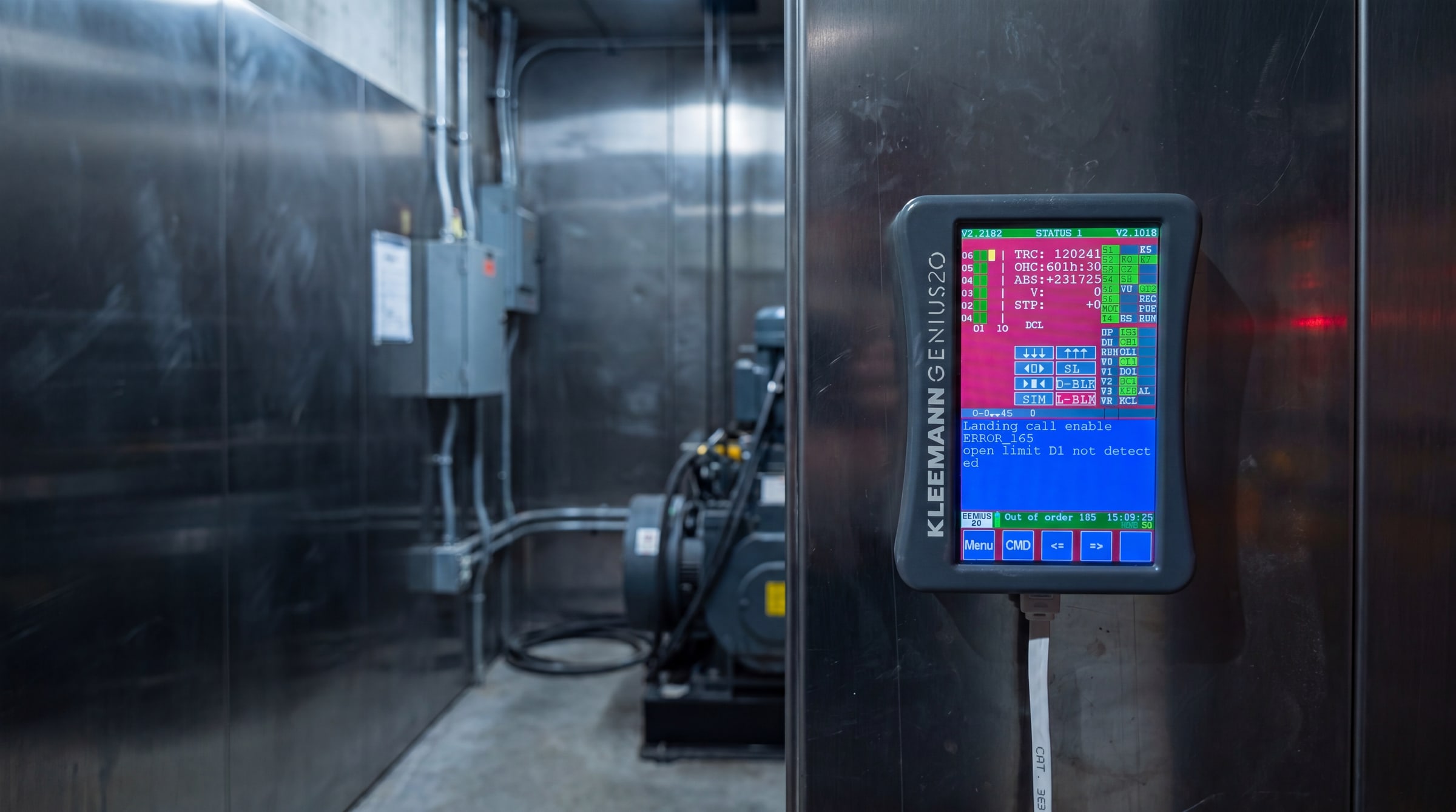

The autodialler is the least glamorous part of a lift and one of the most important. When a passenger is trapped, it is the single piece of equipment standing between a frightening few minutes and a genuine emergency. If the line is dead, nothing else about the lift matters in that moment.
This guide is for the people who carry the duty: property managers, facilities leads and building owners. It covers what the emergency phone is required to do, how it should be tested, why test calls fail more often than people expect, and the deadline that every duty holder with an older lift needs to have in their diary.
What an autodialler actually does
An autodialler is the emergency communication unit fitted inside a lift. When a passenger presses and holds the alarm button, the autodialler places a call to a pre programmed number. That number should reach a person who can confirm help is on the way and stay on the line. In a well set up building that is a 24 hour monitoring centre or a staffed control room. The unit also lets that person speak back into the car, so the trapped passenger hears a calm human voice rather than a ringing tone.
Modern units are usually GSM based, using a mobile SIM, or connected over the building network. Older units sit on a traditional analogue phone line. The technology matters, because it determines how the unit can fail and what the switch off of the old network means for you.
What EN 81-28 requires
EN 81-28 is the European standard covering remote alarms on passenger and goods passenger lifts. In plain terms it requires a two way voice communication system between the lift car and a rescue service that is staffed around the clock. The key points a duty holder should understand are straightforward.
- The alarm must reach a person, not a recording. A trapped passenger needs two way speech with someone who can act.
- The system must confirm that the alarm has been received, so the passenger knows their call has registered.
- It must keep working during a mains power cut, which is why these units carry a backup battery.
- It must be possible to identify which lift the alarm is coming from, so help is sent to the right car.
EN 81-28 sits alongside, not instead of, your wider duties. The Lifting Operations and Lifting Equipment Regulations still apply to the lift as a whole, and the emergency communication system forms part of what a thorough examination will look at. If you want the bigger compliance picture, our guide to LOLER inspections covers how the pieces fit together.
How often the emergency phone must be tested
The unit needs to prove it works on a regular basis. Good practice, and the expectation built into most professional maintenance regimes, is a test call at defined intervals so that any failure is caught quickly rather than discovered during a real entrapment. A monitored system also performs an automatic periodic check in, so the monitoring centre is alerted if a unit stops reporting.
The detail that catches duty holders out is evidence. A test call is only useful if someone records that it connected, that the audio worked in both directions, and that the responder answered. A line in a maintenance sheet that simply says alarm tested is not enough if the call never actually reached a person. Ask your contractor for test call records that show the connection, not just a tick.
The question to ask is not did you test the alarm. It is did the alarm reach a person who answered, and can you show me the record.
Why test calls fail
In our experience, a dead emergency phone almost always comes down to one of five causes.
1. The line itself
The most common failure is the connection. An analogue line that has been ceased, a SIM that has run out of credit or been deactivated, or a network outage will all leave the unit unable to dial out. Because nothing looks wrong from inside the lift, the fault stays invisible until a test call or a real emergency exposes it.
2. The backup battery
Autodiallers carry a battery so they keep working in a power cut. Batteries age, and a tired battery may hold just enough charge to seem fine on mains power but fail the moment it is actually needed. Battery condition is one of the first things a competent engineer checks.
3. Mobile signal
GSM units depend on a usable signal where the unit is mounted, which is often a motor room or a shaft, neither known for good reception. A unit that worked at installation can drift to the edge of coverage as nearby networks change, leaving calls that drop or never connect.
4. Programming and the answer point
If the number programmed into the unit is wrong, out of date, or points at a desk phone that is no longer monitored, the call goes nowhere useful. We see units still dialling a number for a managing agent who moved on years ago. The hardware is healthy. The destination is not.
5. The monitoring arrangement
Where calls route to a monitoring centre, the contract for that service has to be live and the lift has to be registered on it. A lapsed monitoring contract, or a lift that was never added after a handover, means the call arrives nowhere. This is a frequent casualty when a building changes maintenance provider, which we cover in our guide to switching lift maintenance provider.
The analogue switch off, and why it matters now
The traditional analogue telephone network is being retired across the United Kingdom, with services moving to digital. For lifts this is not a minor upgrade. An autodialler sitting on an old copper line will stop being able to make calls once that line is withdrawn, and a lift cannot legally carry passengers without a working emergency communication link.
The fix is to move the unit onto a resilient digital or GSM based solution before the line goes, not after. If you do not know what your lift emergency phones are connected to, that is the first thing to establish. A quick audit now is far cheaper than an emergency replacement when a line is ceased without warning. Our autodialler service includes surveying what you have and moving units onto a compliant connection.
Who is responsible
As with the rest of lift compliance, the duty sits with the duty holder, usually the building owner or the managing agent acting for them. The maintenance contractor tests and maintains the unit. The monitoring centre answers the calls. None of those parties absorbs your legal responsibility for ensuring the lift has a working emergency phone. Knowing who does what, and holding the records that prove it, is the duty holder's job.
A simple cadence that keeps you covered
- Know what each lift is connected to. Analogue line, GSM SIM, or network. You cannot plan for the switch off if you do not know where you stand.
- Confirm test calls reach a person. Ask for records that show the call connected and was answered, not just that the alarm was pressed.
- Check the answer point is current. When staff or agents change, confirm the programmed number still reaches someone who can act.
- Keep monitoring contracts live. Verify every lift is registered on the monitoring service, especially after a provider change.
- Treat a dead phone as out of service. If the emergency communication fails, the lift should not carry passengers until it is restored.
Where Durant Lifts fits in
We install, test and maintain lift autodiallers across London, Kent and the South East, and we move units off analogue lines before the switch off forces the issue. Test call evidence and battery checks run through Durant OS, our client platform, so when you need to show a lift has a working emergency phone, the record is one click away. If you are not sure what your emergency phones are connected to, we will survey them and tell you plainly.
Not sure your lift emergency phones still work?
We test, repair and upgrade lift autodiallers across London, Kent and the South East, and move units off analogue lines before they are switched off. Ask for an audit of what your lifts are connected to.