
Lesson 2 of 3Lifecycle and modernisation
A modernisation project, step by step.
Modernising a lift means replacing its main parts while keeping what is still sound. Done well, it is a planned project with clear stages. Here is what happens at each one, who is involved and what to ask for before the lift goes back into service.
What modernisation means.
Modernisation means replacing or upgrading the main parts of an existing lift, such as the controller, drive, machine, doors and fixtures, while keeping parts that are still sound, such as the guide rails. It can be done in one go or in stages over several years.
Whatever the scope, the first rule is that the lift must not end up less safe.
The starting point
“When undertaking modifications to an existing lift, the overarching consideration should be the retention of at least the existing level of safety. Under no circumstances should the lift installation be less safe after the modifications have been made.”
Modernisation is also a chance to improve safety. The same guidance says: “There is no legal requirement to bring the level of safety of an existing lift up to modern requirements. However, it would be prudent to carry out an audit to BS EN 81-80 to establish by risk assessment those measures which should be applied.” BS EN 81-80 is the standard for improving the safety of existing lifts.
Deciding whether to repair, modernise or replace comes first. Our guide to repairing or replacing an ageing lift covers that decision. This lesson follows the project once you have decided to modernise.
The eight stages.
Every project is different, but most follow this order. Step through the stages to see what happens at each one.
Survey and audit
An engineer inspects the lift and reports on the condition of each part, which parts are obsolete and what the safety audit finds. NHS guidance recommends an audit to BS EN 81-80 “to assess the existing level of safety and determine what changes are necessary to bring the level to today’s state of the art”. Ask for the survey report in writing.
Priorities and programme
The audit should show which items matter most. NHS guidance says that “A list of priorities should be established and a dated programme of work agreed.” Decide whether to do everything at once or in stages, and when the lift can be out of service.
Budget and consultation
Set the budget and check who pays. If leaseholders contribute through their service charge, the law may require you to consult them before agreeing the works. The section on consulting leaseholders, below, explains how.
Specification and tender
Write down what is to be replaced, the standards to follow and what must be handed over at the end. NHS guidance says modernisations should conform to BS 5655-11 for traction lifts or BS 5655-12 for hydraulic lifts. In our view, also ask each bidder about spare parts, any special tools or software needed for maintenance, how long the lift will be out of service and how it will be tested.
Preparation
Plan for safety and for the people who use the building. Lift installation is construction work, so the CDM Regulations apply. Tell residents and users early, and plan for anyone who cannot use the stairs. The section on safety during the works, below, has more.
Works on site
The lift is handed over to the installer and taken out of service. The landings are barriered and signed, old equipment is removed and the new parts are installed. In our experience, regular progress updates for residents make a long outage easier to live with.
Testing and examination
The installer tests the lift. NHS guidance says that after important changes “It is essential that tests be conducted to ensure that the main changes and any consequential changes result in a safe installation.” Then a competent person carries out a thorough examination before the lift carries people again.
Handover
The lift goes back into service. Collect the documents, tools and software it needs, train building staff on anything new, and update your maintenance contract. The handover section, below, lists what to ask for.
Consulting leaseholders.
In blocks with leaseholders, the cost of lift works usually comes through the service charge. In England, section 20 of the Landlord and Tenant Act 1985 limits what a landlord can recover for qualifying works unless it has consulted the leaseholders, or a tribunal has agreed to dispense with consultation.
The law
“For the purposes of subsection (3) of section 20 the appropriate amount is an amount which results in the relevant contribution of any tenant being more than £250.”
The Service Charges (Consultation Requirements) (England) Regulations 2003, regulation 6
So if any leaseholder would pay more than £250 towards the works, the consultation applies. For works that do not need public notice, the steps include:
- a notice of intention to each leaseholder, describing the works and why they are needed, and inviting written observations;
- giving leaseholders 30 days to comment, and to name a contractor the landlord should ask for an estimate;
- having regard to the observations, and obtaining estimates;
- a statement to leaseholders setting out at least two of the estimates, with a summary of the observations and the landlord’s response.
These steps add weeks to the programme, so start early. This is general guidance for England only, not legal advice; take advice on your own leases. A lift maintenance contract that runs for more than a year is a separate test, explained in our post on Section 20 and lift maintenance contracts.
Safety during the works.
Installing or removing a lift is construction work. The CDM Regulations define construction work to include “the installation, commissioning, maintenance, repair or removal of mechanical, electrical, gas, compressed air, hydraulic, telecommunications, computer or similar services which are normally fixed within or to a structure”.
As the client, you must make suitable arrangements for managing the project, including enough time and resources, and give the designers and contractors the information about the building that they need to plan the work safely. Larger projects must also be notified to HSE.
The law
“A project is notifiable if the construction work on a construction site is scheduled to— (a) last longer than 30 working days and have more than 20 workers working simultaneously at any point in the project; or (b) exceed 500 person days.”
The Construction (Design and Management) Regulations 2015, regulation 6(1)
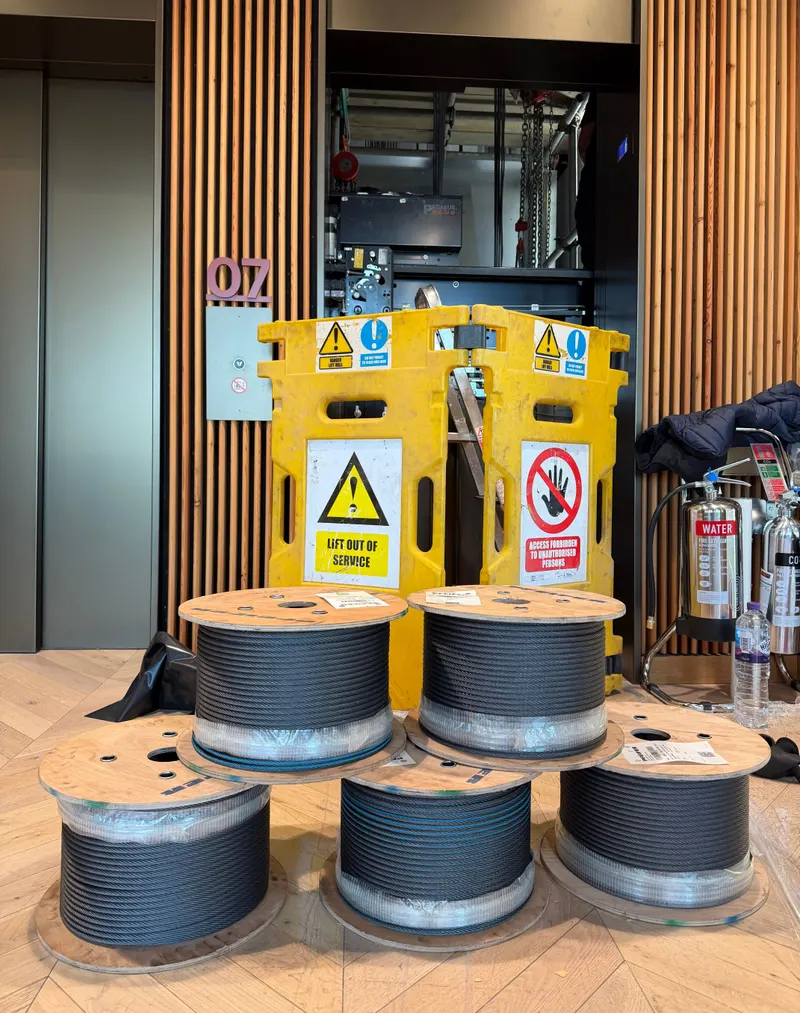
The installer is responsible for working safely in the shaft and keeping people away from open landings. LEIA’s code of practice points to BS 7255 for barriers at landings. Your part is to keep residents and visitors informed and away from the work area.
Safety first
Plan early for people who cannot use the stairs. In our experience, that means talking to residents who rely on the lift, arranging help with shopping and deliveries, and avoiding moves during the works. In our view, if the lift is a firefighting or evacuation lift, tell your fire risk assessor before it goes out of service. Our lesson on firefighting and evacuation lifts explains why.
Testing and examination.
NHS guidance describes two levels of testing. Where the rated speed, rated load or mass of the lift changes, or its travel increases, the whole installation should be tested to BS 8486. Where parts such as the control system, the type of door, safety components, the machine, brake or traction sheave, the door operator or the guide rails are replaced, tests should confirm that both the changes and any knock-on effects leave the lift safe.
For lifts installed before 1 July 1999, where parts are replaced like for like, the guidance says the test can follow the test document for the lift’s original date of installation. Where modern replacement equipment is used, the test should be to BS 8486.
Then the lift needs a thorough examination by a competent person before it is used again. The law requires one when “exceptional circumstances which are liable to jeopardise the safety of the lifting equipment have occurred”, and HSE’s code of practice is clear about modifications:
The law
“A thorough examination is required after substantial or significant modification or repair.”
Our lessons on reading a LOLER report and supplementary tests explain what the examiner looks at.
Handover.
A new lift must come with instructions, including plans and diagrams for normal use, maintenance, inspection, repair, periodic checks and rescue, and a logbook. That rule is for new lifts, but in our view it is the right benchmark after a modernisation too. Ask for:
- updated drawings, wiring diagrams and manuals for the new equipment;
- test certificates and the thorough examination report;
- any special tools, software and access codes needed to maintain the lift. LEIA’s code of practice expects the information manual to cover these;
- warranty details, and who to call during the warranty period;
- training for building staff on anything new, such as alarms, fire controls or remote monitoring.
Then update your maintenance contract to cover the new equipment, and your records to show what was replaced and when. If accessibility was part of the scope, NHS guidance points to BS EN 81-82 for improving the accessibility of existing lifts.
Our lift modernisation team can survey your lift and help plan each stage.
Check your understanding.
Three quick questions on this lesson. Choose an answer to check it, or open the answer below each question.
-
Your lift is being modernised. Does the law require it to meet every current standard for new lifts?
Show the answer
B. No, but it must be at least as safe as before, and an audit shows which improvements to make. NHS guidance notes there is no legal requirement to bring an existing lift up to modern requirements, but recommends an audit to BS EN 81-80, and says a lift should never be less safe after modifications.
-
The works on your lift are finished and the installer has tested it. What else should happen before it carries passengers?
Show the answer
B. A thorough examination by a competent person. HSE’s approved code of practice says a thorough examination is required after substantial or significant modification or repair.
-
You manage a block in England. The modernisation will cost each leaseholder about £2,000. What do you need to do first?
Show the answer
B. Consult the leaseholders under Section 20 before agreeing the works. In England, Section 20 consultation applies to qualifying works when any leaseholder’s contribution would be more than £250, unless a tribunal agrees to dispense with it.
Sources.
The primary sources for this lesson. We checked them when the lesson was last updated on 18 October 2026. How we research and check our lessons.
Finished this lesson? Mark it as complete to see your progress on the course page. This is saved in your browser only.
Keep learning.
Related reading
Planning a modernisation?
We survey the lift, set out priorities and a programme, and can provide a clear specification and estimate you can consult on.
Common questions.
Quick answers to common questions about this topic.
What is lift modernisation?
Replacing or upgrading the main parts of an existing lift, such as the controller, drive, machine, doors and fixtures, while keeping parts that are still sound, such as the guide rails. It can be done all at once or in stages.
Does a modernised lift have to meet current standards?
There is no general legal requirement to bring an existing lift up to modern standards. Modernisation must leave the lift at least as safe as it was, and NHS guidance recommends an audit to BS EN 81-80 to decide which safety improvements to make.
Do leaseholders have to be consulted on lift modernisation?
In England, if the works would cost any leaseholder more than £250, the landlord must follow the Section 20 consultation process before agreeing them, or the amount it can recover is limited, unless a tribunal agrees to dispense with consultation.
Does a lift need a thorough examination after modernisation?
Yes. HSE’s approved code of practice says a thorough examination is required after substantial or significant modification or repair. The lift should also be tested by the installer once the work is finished.