
Lesson 1 of 4Faults and breakdowns
How engineers diagnose lift faults.
When a lift stops, the engineer has two questions to answer: where is the fault, and why did it happen? Here is how they trace it through the safety circuit and the lift’s history, and how building teams can help.
Why a lift stops.
A lift is designed to stop whenever something is not as it should be. A landing door that has not locked, a car door that is open or a safety device that has operated will all stop it, and keep it stopped until the problem is cleared.
That is a legal requirement. The Lifts Regulations 2016 say that lift electrical equipment must be installed so that the “movements of the lift are dependent on electrical safety devices in a separate electrical safety circuit”, and so that “a fault in the electrical installation does not give rise to a dangerous situation.”
The law
“An interlocking device must prevent during normal operation— (a) starting movement of the car, whether or not deliberately activated, unless all landing doors are shut and locked”.
The safety circuit is a chain of switches wired one after another through the lift: the landing door locks, the car door contact, the governor, the safety gear, the buffers, the pit stop switch and others. If any one of them opens, the circuit is broken and the controller stops the lift.
Not every stop comes from the safety circuit. Our lift faults page lists the usual causes of a lift that will not move or keeps stopping: power supply interruptions, drive or controller faults, or a safety circuit stopping the lift. The engineer’s first job is to work out which.
Our lessons on lift doors, lift controllers and safety systems explain the parts involved.
Tracing a break in the safety circuit.
Door locks are a common reason for a lift to stop. Step through this simplified example, in which one landing door lock is not making contact.
Every switch closed
Current flows from the controller through every switch and back. The controller sees a complete circuit, so the lift can run.
One switch opens
The lock on the floor 3 landing door does not make contact, perhaps because the door has not closed fully or the lock is worn. The circuit is broken, the lift stops and the controller records a fault.
The controller narrows it down
Many controllers check the circuit at points along its length. Here, voltage reaches points A and B but not C, so the break is somewhere in the landing door locks.
The engineer measures
With a meter and the wiring diagram, the engineer checks the landing door section lock by lock. Voltage reaches the floor 3 lock but not beyond it, so that lock is the open switch.
Fix the cause, then test
The engineer finds out why the lock did not make, such as door alignment, wear or damage, and puts it right. Then they check that every lock and safety switch works before the lift goes back into service.
From report to repair.
Every fault is different, but a careful engineer follows the same pattern: find where the fault is, find why it happened, then fix and prove the repair.
Listen to the report
What did people see or hear, when, and at which floor? Was anyone trapped? A clear report from the building can save time on site.
Make the lift safe to work on
The engineer takes control of the lift before working on it, following a safe system of work. BS 7255 is the code of practice for safe working on lifts, and the Lifts Regulations 2016 require that before anyone enters the space the car travels in, “normal use of the lift must be made impossible.”
Read the history
The controller’s fault log, the logbook and recent call-outs show what happened and how often. Our lesson on lift fault codes explains what the log can tell an engineer.
Find where the fault is
The engineer uses the controller’s indicators, a meter and the wiring diagrams to narrow the fault down to one part of the lift. The Lifts Regulations 2016 require each new lift to come with instructions containing “the plans and diagrams necessary for normal use and relating to maintenance, inspection, repair, periodic checks and the rescue operations”.
Find why it happened
A switch that has opened is a symptom. The cause might be a misaligned door, a worn part, a loose connection, water or damage. Fixing only the symptom means the lift will stop again.
Repair and test
Once the cause is put right, the engineer tests the lift, including the safety circuit, before it goes back into service. If the fault cannot be fixed straight away, the lift stays out of service until it can be.
Record what was found
The visit record should say what the fault was, what caused it, what was done and anything still outstanding, so the next engineer has the full history. Our lesson on keeping a lift logbook covers what to keep.
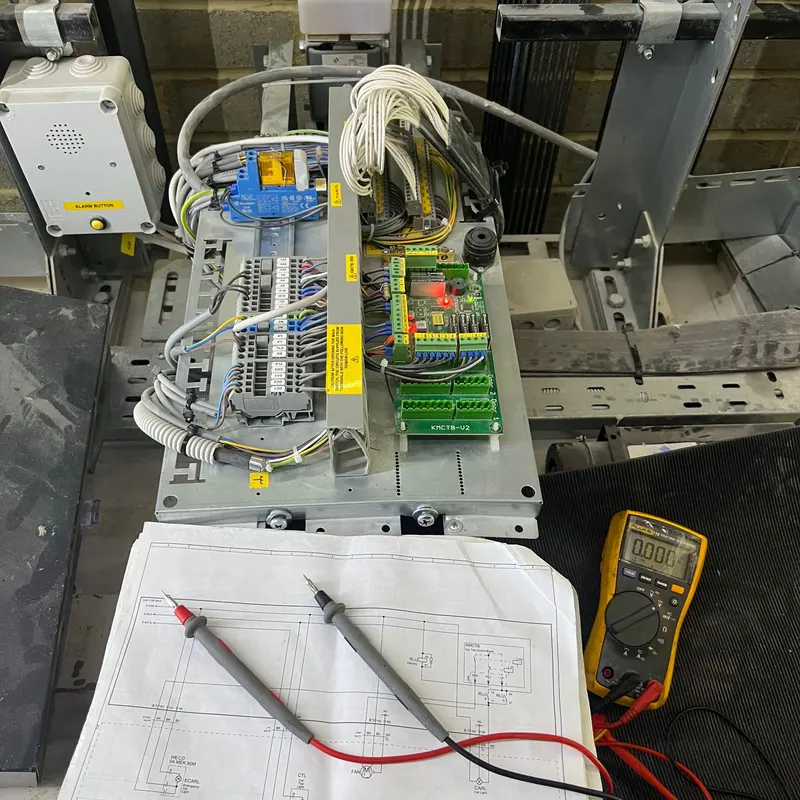
Working safely on live circuits.
Some fault finding can only be done with the circuit switched on, because the engineer needs to see where the voltage stops. The law sets tight limits on that kind of work.
The law
Nobody may work on or near a live conductor where danger may arise unless “(a) it is unreasonable in all the circumstances for it to be dead; and (b) it is reasonable in all the circumstances for him to be at work on or near it while it is live; and (c) suitable precautions (including where necessary the provision of suitable protective equipment) are taken to prevent injury.”
Regulation 16 adds that nobody may do work that needs technical knowledge or experience to prevent danger unless they have it, or are suitably supervised. In practice, that means trained lift engineers with the right instruments, working to a safe system of work. NHS guidance for hospitals says lift machine rooms should be kept locked, with access only for trained and authorised people.
Engineer’s note
In our view, a lift must never go back into service with any part of its safety circuit bridged or bypassed. If a fault cannot be fixed on the visit, the lift should stay out of service, with clear notices, until it can be.
Intermittent faults.
The hardest faults are the ones that come and go. An intermittent fault might stop the lift twice a week and then disappear for a month, and the lift may be working normally when the engineer arrives.
In our experience, the pattern is often the clue. A fault that only happens at one floor points to that floor’s door equipment. One that comes after heavy rain may point to water. One that happens at the busiest times may point to wear, heat or a door that is being held or pushed.
Notes from the building are valuable here. For each stop, record:
- the date and time
- the lift and the floor it stopped at, or between
- what it was doing, such as closing its doors or starting to move
- any message or code on the display
- anything else you noticed, such as a noise, a smell, the weather or a power cut
The engineer can match those notes to the fault log. Our lift faults page explains that intermittent faults may need further investigation, and our guide to common lift faults sets out which faults need a call straight away and which can wait.
A reset is not a repair.
Resetting a controller clears the fault it has recorded, and the lift may run again. But the reason it stopped is still there, so it is likely to stop again.
Our Greenwich case study shows what that looks like. The only lift in a residential block had broken down more than ten times in a few weeks. Each time, the routine had been the same: reset the controller and hand the lift back. When our engineer read the whole fault history instead, three repeating faults pointed to the drive, its programming and the brake. The drive was refurbished, its settings retuned and the brake re-set by hand.
What building teams can do.
Diagnosis is work for lift engineers, but building teams make it faster and safer:
- Keep people safe. If the lift seems unsafe, stop people using it and follow your site procedure.
- If anyone is trapped, call your lift contractor’s emergency number straight away, or 999 if someone is in danger.
- Note the lift, the floor, the time and any message on the display, from a safe position.
- Report the fault straight away, and record it in the logbook with who you told.
- Keep notes of every stop if the fault keeps coming back.
Safety first
Never open a landing door, enter the shaft, pit or machine room, or try to free trapped passengers. Leave resets and isolation to your lift contractor, unless they have trained and authorised you to do them for that lift. Our breakdown response plan sets out the steps for site staff.
Check your understanding.
Three quick questions on this lesson. Choose an answer to check it, or open the answer below each question.
-
A lift will not move, and the controller shows that the safety circuit is open in the landing door section. What does that tell the engineer?
Show the answer
B. A landing door lock, or its wiring, is not making contact, so the next step is to find which one. The controller has narrowed the break down to one part of the circuit. The engineer then checks that section, lock by lock, to find the one that is open, and then works out why.
-
Why is a reset not a repair?
Show the answer
A. A reset clears the fault from the controller, but not its cause, so the fault is likely to come back. A reset can get a lift moving, but the reason it stopped is still there. In our Greenwich case study, repeated resets kept failing until the fault history led our engineer to the drive, its programming and the brake.
-
Your lift sometimes stops between floors, but works normally whenever the engineer arrives. What helps most?
Show the answer
C. A note of each stop: the date, time, floor, what the lift was doing and any message on the display. Intermittent faults are hard to catch. A record of each stop helps the engineer match it to the fault log and spot a pattern, such as one floor, one time of day or wet weather.
Sources.
The primary sources for this lesson. We checked them when the lesson was last updated on 18 October 2026. How we research and check our lessons.
Finished this lesson? Mark it as complete to see your progress on the course page. This is saved in your browser only.
Keep learning.
Related reading
Lift keeps stopping?
Our engineers read the fault history, trace the cause and fix it, rather than resetting the lift and leaving. Tell us what is happening and we will arrange a visit.
Common questions.
Quick answers to common questions about this topic.
What is a lift safety circuit?
A chain of switches wired in series through the lift’s doors, car, shaft and pit. If any switch opens, for example because a landing door is not locked, the circuit is broken and the controller stops the lift. The Lifts Regulations 2016 require a lift’s movements to depend on electrical safety devices in a separate safety circuit.
Why does my lift keep breaking down?
Repeat breakdowns usually mean the cause has not been found, for example because the lift has been reset rather than repaired. An engineer should read the fault history, trace where the fault is and fix the reason it happens.
How long does it take to find a lift fault?
It depends on the fault. In our experience, a fault that is present when the engineer arrives can often be traced on the first visit. An intermittent fault may need the fault history, notes from the building and sometimes more than one visit.
Can building staff reset a lift?
Only if your lift contractor has trained and authorised them to do so for that lift. Otherwise, report the fault and leave resets, isolation and access to the equipment to the contractor.