
Lesson 2 of 4Faults and breakdowns
What lift fault codes mean.
Lift controllers record a code each time they detect a fault, and some show it on the display in the car. Here is what those codes can tell you and your engineer, and what they cannot.
What a fault code is.
A lift’s controller checks the lift constantly: the safety circuit, the doors, the drive, the motor, the load and more. When it detects something wrong, it records a fault code, usually with the time and the floor, in its fault log.
Some lifts show a message or code on the display in the car or at the landings. Engineers can usually see much more, on the controller itself or on a service tool that plugs into it.
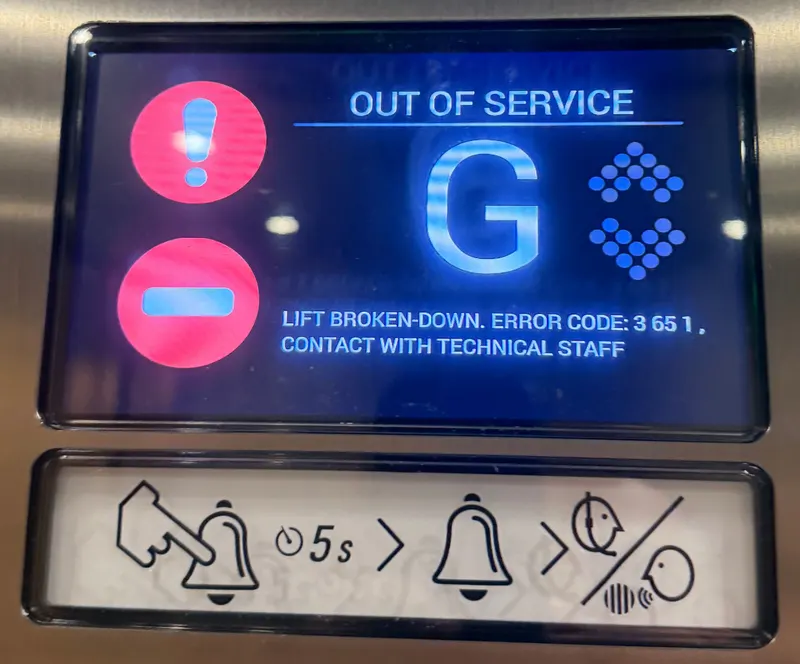
What lift users see
What the engineer sees
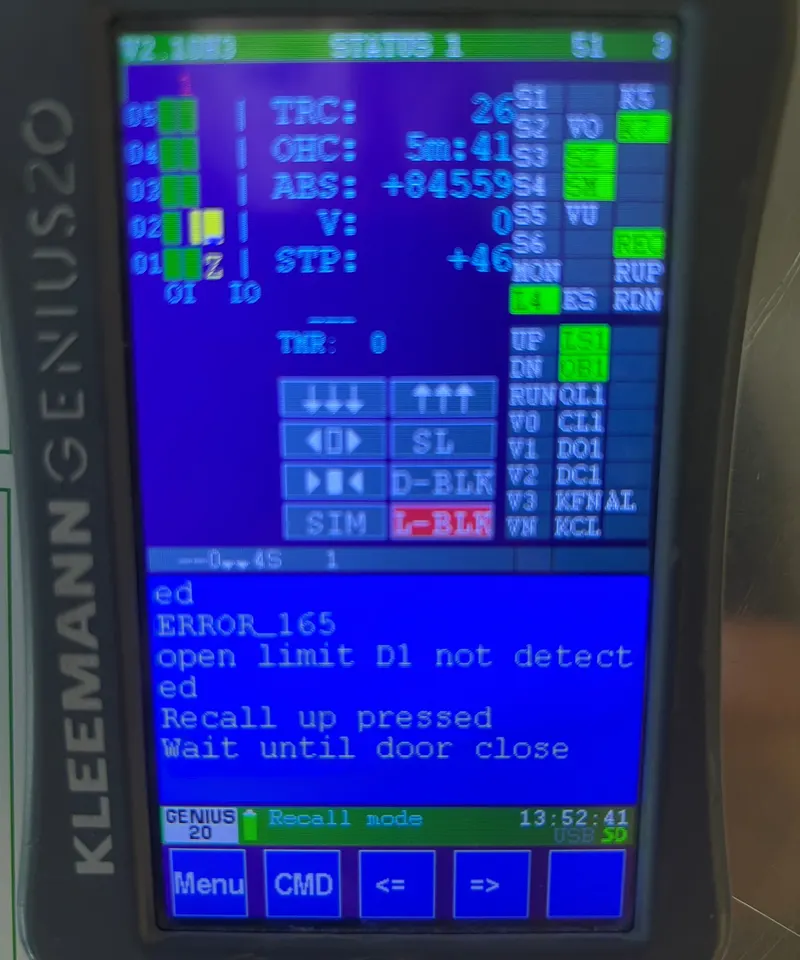
The car display gives users a code and tells them to contact technical staff. The service tool shows the engineer the fault in words: the door’s open limit was not detected. Neither says why.
Reading a fault log.
Fault logs look different on every controller, but most entries hold the same kinds of information. Select a number to see what each part tells the engineer.
Fault code
The controller’s code for what it detected. Each manufacturer sets its own codes, and in our experience they can differ between controller models from the same maker, so a code only means something alongside that lift’s documentation.
Description
Many controllers show a short description with the code. It names what the controller detected, here an open landing door lock, but not why it happened.
Date and time
Lets the engineer match the entry to reports from the building and to other entries. If the controller’s clock is wrong, the times will be too.
Floor
Where the car was when the fault happened. The same fault at the same floor points to that floor’s equipment, such as its landing door.
What the lift was doing
Some controllers record whether the lift was travelling, levelling or working its doors. A door lock fault as the doors close tells a different story from one in the middle of a journey.
Repeats
Entries 45 to 47 show the same code at the same floor three times in two days. In our view, the pattern across many entries tells an engineer more than any single code.
Why codes differ between lifts.
There is no universal list of lift fault codes. Each manufacturer designs its own controllers and sets its own codes, so a number that means a door fault on one lift can mean something quite different on another.
Every new lift should come with instructions containing the plans and diagrams needed for its maintenance, inspection and repair, under the Lifts Regulations 2016. In our experience, the documentation for that lift, or the manufacturer’s service tool, is the only reliable guide to what its codes mean.
Engineer’s note
In our view, avoid acting on code lists found online. They may belong to a different make, model or software version, and even the right meaning only tells you what the controller detected.
A code is where diagnosis starts.
A code names a symptom. Finding the cause is still the engineer’s job, using the fault history, the lift’s behaviour, a meter and the wiring diagrams. Our lesson on how engineers diagnose faults walks through that process.
Our Greenwich case study is an example. The fault log showed three families of faults, printed in the case study as 011 VVVF FAULT, OC1 OVERCURRENT and F11 OVERLOAD. None of them said what to repair. Read together, they pointed to the drive, its programming and the brake, and that is where the repeat faults were finally fixed.
Our lift repairs service traces controller error codes and clears them at source, rather than clearing the code and leaving the cause in place.
Special tools and access codes.
Some controllers only show their full fault log, or let an engineer change settings, through the manufacturer’s own service tool or software. LEIA’s code of practice for lift maintenance calls these special tools: tools or software essential for maintenance that can only be bought from the original manufacturer.
The code of practice says that the information manual for a lift includes how to use any essential special tools, and the software access codes. At the end of a maintenance agreement, documents, drawings, tools, special tools and software access codes provided by the building should be handed back. It adds that the contractor should make no changes that leave the lift “not maintainable by the subsequent maintenance provider.”
NHS guidance for hospitals goes further: special tools, “whether hardware or software”, should be provided with each lift or group of lifts and should remain on site.
Engineer’s note
In our view, when you buy, modernise or change the contractor for a lift, ask which special tools and access codes it needs and who holds them. It is much easier to sort out before a fault than during one. Our guide to switching lift maintenance provider covers the handover.
If you see a fault code.
The code is useful information for your contractor. From a safe position:
- Note the code exactly as shown, or take a photo of the display.
- Note the lift, the floor, the time and what happened, such as a sudden stop or doors that would not close.
- Check whether anyone is trapped. If they are, call your lift contractor’s emergency number straight away.
- Report the fault, and record it in the logbook with who you told.
Our lift faults page sets out what else to tell the engineer. If your staff are expected to do anything when a lift shows a fault, the Provision and Use of Work Equipment Regulations 1998 (PUWER) require their employer to give them adequate health and safety information and, where appropriate, written instructions, including on “foreseeable abnormal situations and the action to be taken if such a situation were to occur”. Agree those instructions with your lift contractor.
Safety first
Do not reset the lift, switch it off or clear the code unless your lift contractor has trained and authorised you to do so for that lift. Never open a landing door or try to free trapped passengers. Clearing a code does not fix the fault.
Check your understanding.
Three quick questions on this lesson. Choose an answer to check it, or open the answer below each question.
-
A lift display shows code E21, and a website says E21 means a drive fault. What should you assume?
Show the answer
B. Nothing yet. Codes differ between manufacturers, so report the code and let your engineer check it against that lift’s documentation. Codes are set by each manufacturer, and a list found online may belong to a different make or model. Your engineer reads the code with the lift’s own documentation or service tool.
-
What should you note when a lift shows a fault code?
Show the answer
C. The code, the lift, the floor, the time and what happened. The controller may store the code, but your notes say what people experienced, when the lift was out of service and whether anyone was trapped. Together, they help the engineer find the cause.
-
A fault log shows the same door lock code at floor 3 five times in a week. What does that suggest?
Show the answer
A. The equipment at floor 3, such as its landing door and lock, is the place to start. A repeating code at one floor is a pattern, and patterns point to causes. The engineer would check that floor’s landing door, its lock and its alignment first.
Sources.
The primary sources for this lesson. We checked them when the lesson was last updated on 18 October 2026. How we research and check our lessons.
Finished this lesson? Mark it as complete to see your progress on the course page. This is saved in your browser only.
Keep learning.
Related reading
Seeing the same code again and again?
We read the fault history, trace the cause and fix it at source, rather than clearing the code and leaving. Tell us what the lift is showing and we will arrange a visit.
Common questions.
Quick answers to common questions about this topic.
Is there a universal list of lift fault codes?
No. Each manufacturer sets its own codes, and in our experience they can differ between controller models from the same maker. Only the documentation for that lift, or the manufacturer’s service tool, says what a code means.
What does an error code on a lift display mean?
It means the controller has detected a fault and recorded it. The code tells an engineer where to start looking, but not what caused the fault or how to fix it. Note the code, the floor and the time, and report it to your lift contractor.
Can I clear a lift fault code myself?
Only if your lift contractor has trained and authorised you to reset that lift. Clearing a code does not fix the fault, and restarting a lift that stopped for a safety reason could put people at risk.
What are special tools for lifts?
Tools or software needed to maintain a lift that can only be bought from the original manufacturer. LEIA’s code of practice says special tools and software access codes provided with a lift should be handed back when a maintenance contract ends, so the next contractor can maintain it.